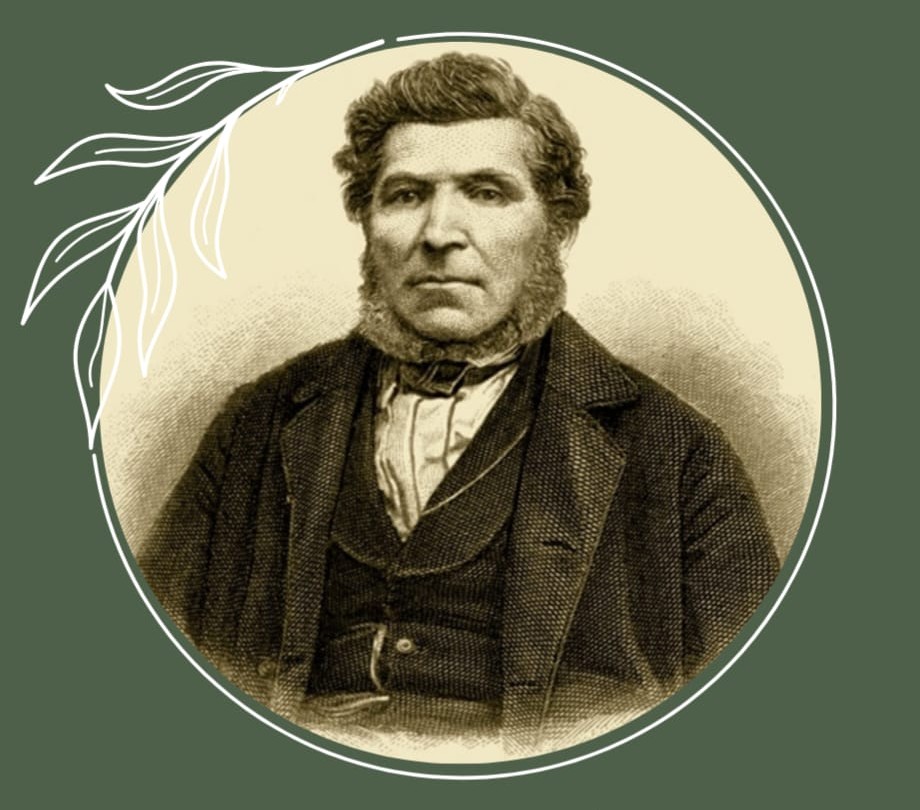
Ernests Dinsbergs (1816–1902)
Ernests Dinsbergs was born in Dundaga on January 24, 1816, in the “Iernieki” homestead to a family of servants. Within just two months of attending the Dreimaņi Manor school, he learned to read, and while writing, he mastered through self-education. Later, Dinsbergs became a prominent cultural and educational figure in Dundaga and its surrounding area. He was an outstanding teacher and poet whose work and personality left a lasting impact on Latvian culture.
In 1838, he was appointed as a teacher at the first parish school of Kubele in Dundaga. There, together with his colleague, writer Frīdrihs Mālbergs, and his student Krišjānis Barons, he promoted knowledge and contributed to the ideas of the Latvian National Awakening. Dinsbergs not only taught but also wrote poetry and stories in the local Dundaga dialect, and translated works of German and English literature, including Goethe and Homer. He was also the first to adapt the well-known Christmas song “O Christmas Tree” into Latvian.
The breadth of Dinsbergs’ personality is demonstrated by his more than 300 publications in nearly all contemporary periodicals, along with over 100 books of various genres.
Today, the Kubalu School-Museum offers visitors the opportunity to explore the life and work of Ernests Dinsbergs, view his publications, and learn more about his connection to Dundaga. His life story reveals a versatile personality—a teacher, writer, and cultural figure—who successfully combined pedagogy, literature, and public activity.
Ernests Dinsbergs passed away on April 30, 1902, and is buried in Kužnieki Cemetery near the Kubalu School-Museum. His legacy continues to inspire and enrich Latvia’s cultural and educational landscape.